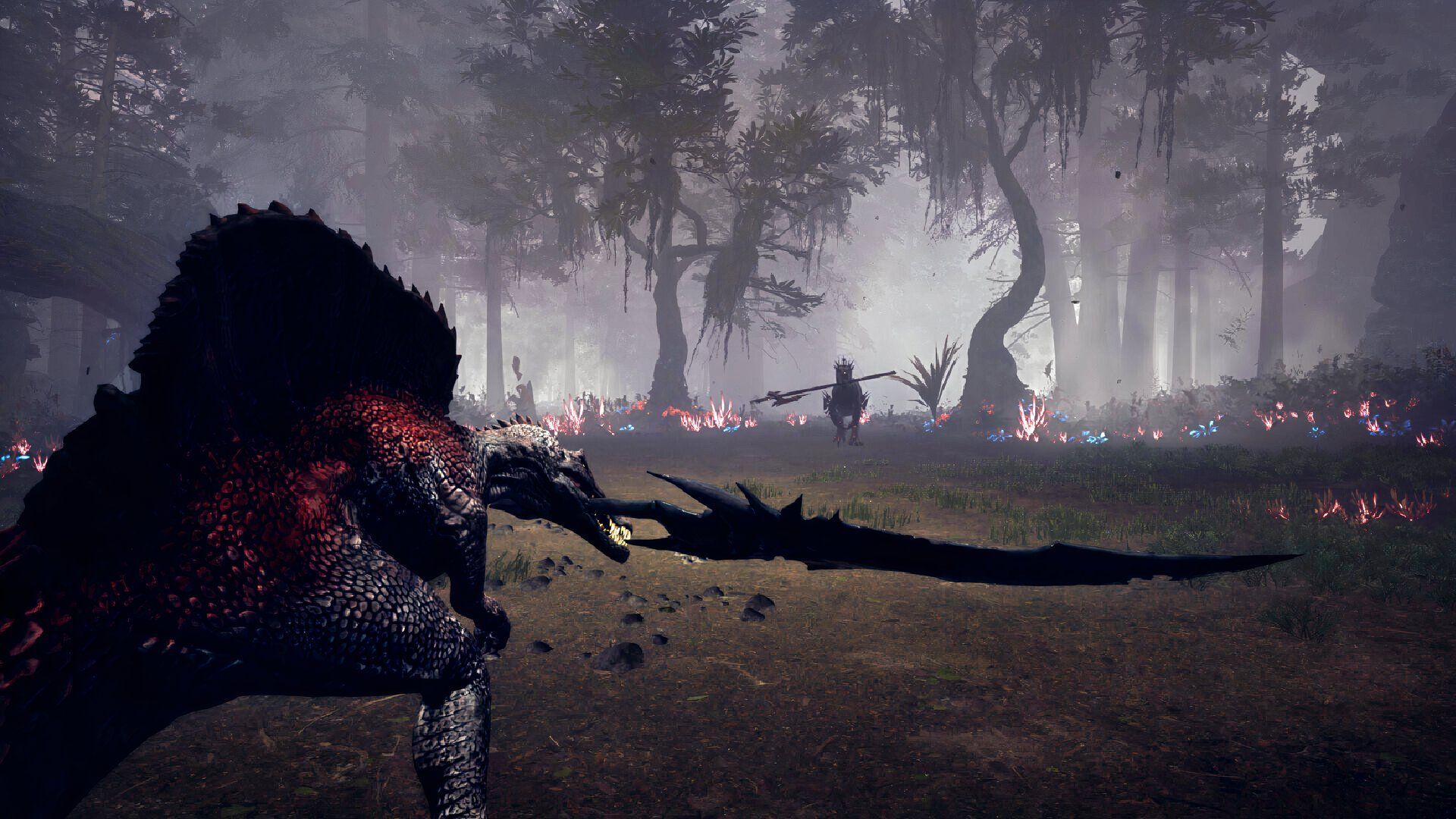
For more than a decade, the Soulslike genre has largely adhered to a familiar and well-worn blueprint. Players typically find themselves wandering through crumbling medieval kingdoms teeming with undead enemies, navigating treacherous gothic castles, or struggling to survive in worlds teetering on the brink of apocalyptic collapse. While many developers have attempted to introduce their own unique flavor and mechanics to the punishing action-RPG experience, the vast majority still follow the tried and true Soulslike pattern that FromSoftware established with Demon’s Souls back in 2009. However, a surprising new contender has emerged that throws out the rulebook entirely, replacing shambling zombies and dark fantasy creatures with something far more unexpected: dinosaurs.
The Soulslike genre owes its existence to the visionary game design of Hidetaka Miyazaki and his team at FromSoftware. Beginning with Demon’s Souls and continuing through the wildly successful Dark Souls trilogy, Bloodborne, Sekiro: Shadows Die Twice, and most recently Elden Ring, the Japanese studio has crafted a unique gaming experience defined by challenging combat, deliberate pacing, cryptic storytelling, and the ever-present threat of losing progress upon death. These games have sold tens of millions of copies worldwide and spawned an entire subgenre of imitators, with titles like Lords of the Fallen, Lies of P, Nioh, and countless others attempting to capture the same magic. Yet despite the genre’s immense popularity, innovation has often felt incremental rather than revolutionary.
Breaking Free from Medieval Monotony
The overwhelming prevalence of medieval European aesthetics in Soulslikes has become both a defining characteristic and a creative limitation. Dark castles, armored knights, grotesque demons, and plague-ridden villages have become so synonymous with the genre that many players and critics alike have begun to question whether there’s room for genuine innovation. Some developers have attempted to break the mold with varying degrees of success. The Surge series transplanted the formula into a science fiction setting with exoskeletons and industrial environments, while Remnant: From the Ashes introduced firearms and procedurally generated worlds. Still, the core identity of most Soulslikes remains rooted in that familiar dark fantasy atmosphere that FromSoftware perfected.
Enter the prehistoric twist that nobody saw coming. The introduction of dinosaurs into the Soulslike formula represents more than just a cosmetic change; it fundamentally alters the player’s relationship with the game world. Instead of facing humanoid enemies with predictable attack patterns derived from medieval weaponry, players must contend with massive reptilian predators whose movements and behaviors are inherently alien and unpredictable. The primal terror of facing a charging Tyrannosaurus Rex or evading the calculated strikes of a pack of Velociraptors creates an entirely different emotional experience than battling yet another armored knight or shambling corpse.
The Evolution of Challenge-Based Gaming
The marriage of dinosaurs and Soulslike mechanics makes surprising sense when examined through the lens of game design philosophy. Both concepts center on the idea of humanity facing overwhelming, seemingly insurmountable challenges. In traditional Soulslikes, this manifests as the lone warrior standing against cosmic horrors and undead legions. With dinosaurs, that same feeling of vulnerability is achieved through the natural terror of prehistoric apex predators. The sense of being small and fragile in a hostile world translates perfectly, perhaps even more effectively, when the threats are massive reptiles that dominated Earth for over 165 million years rather than fictional monsters born from a game designer’s imagination.
Industry analysts have noted that genre fatigue has been setting in among dedicated Soulslike fans. After playing through dozens of games featuring similar aesthetics, enemy types, and world designs, even the most devoted players have begun craving something genuinely fresh. The dinosaur approach addresses this fatigue head-on by providing instantly recognizable yet wildly different adversaries. Every player understands intuitively what a Velociraptor or Triceratops represents as a threat, but few have experienced fighting these creatures in a methodical, skill-based combat system. This combination of familiarity and novelty creates an irresistible hook that traditional fantasy settings can no longer provide.
A New Era for the Genre
The success of dinosaur-themed Soulslikes could signal a broader shift in how developers approach the genre moving forward. Rather than continuing to iterate on the same medieval formula, studios may feel emboldened to explore entirely different historical periods, settings, and creature designs. Imagine Soulslikes set during the Ice Age with massive woolly mammoths and saber-toothed cats, or games that draw inspiration from ancient mythologies beyond European folklore. The dinosaur experiment proves that the core Soulslike mechanics are robust enough to support virtually any setting, provided the execution maintains the genre’s commitment to challenging, fair, and rewarding gameplay.
As the gaming industry continues to evolve, the willingness to take creative risks becomes increasingly valuable. The dinosaur Soulslike phenomenon demonstrates that players are hungry for innovation and willing to embrace unexpected combinations when they’re executed with care and passion. For a genre that seemed destined to repeat itself indefinitely, the prehistoric shake-up offers hope that the best Soulslikes may still be ahead of us, lurking in settings and scenarios that we haven’t yet imagined.
Expert Opinion: The integration of dinosaurs into the Soulslike formula represents a pivotal moment for genre evolution, demonstrating that the underlying mechanics are setting-agnostic and infinitely adaptable. This creative breakthrough will likely inspire a wave of experimental Soulslikes exploring unconventional themes, from prehistoric survival to cosmic horror beyond Lovecraftian tropes. The next five years could see the genre’s most innovative period yet, as developers realize that challenging combat and meaningful death mechanics can thrive in virtually any imaginative setting.